November 6, 2026 · 7-min read
How to Statblock a Bar Patron You Didn't Plan to Fight
The dwarf at the end of the bar was supposed to be flavor text. Now someone's rolling initiative.
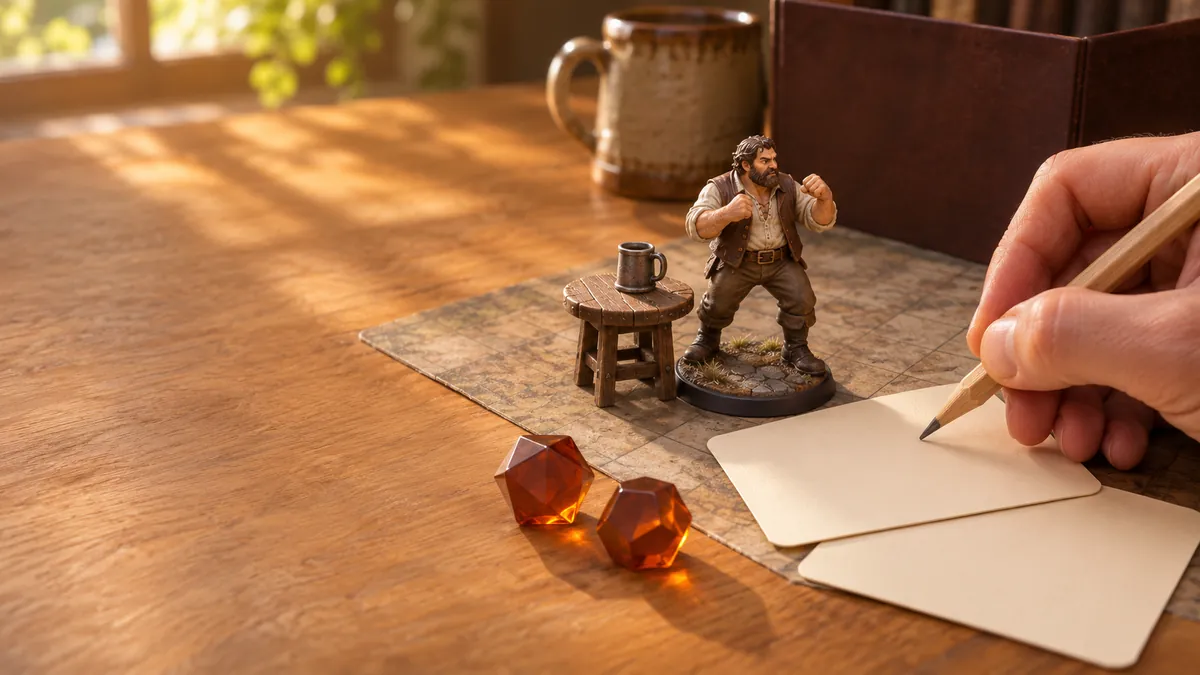
The fastest d&d random npc stat block generator is the one in your own head: grab the closest SRD stat block that matches the patron's build, round their numbers to match party level, and give them one memorable trait. You don't need a tool. You need a method, and about thirty seconds.
This happens in almost every campaign. You describe a grizzled dockhand nursing a mug in the corner, meant purely as color, and your players decide he's definitely the guy who stole their cargo manifest. Now he's standing up, and everyone's looking at you.
Why do random NPCs need stat blocks at all?
Any NPC can become a combatant the moment a player shoves them, insults them, or accuses them of something. If you don't have numbers ready, the scene either stalls while you flip through a book or the NPC becomes a pushover with no mechanical teeth.
A stat block doesn't need to be complex to work. It just needs to exist before the dice start rolling, even if "before" means the ten seconds after someone says "I punch him."
What's the fastest way to build one on the fly?
Skip custom math entirely and borrow from the SRD. These are free, reprintable, and built for exactly this situation.
- Pick the closest archetype. A barmaid, a stable boy, a traveling merchant: all Commoners. A bouncer, a mercenary, a smuggler: Thug. A cutpurse working the crowd: Spy.
- Scale HP to party level loosely. At level 1-3, a Commoner (4 HP) or Thug (32 HP) both feel threatening. At level 8+, bump a Thug's HP up by 10-15 if you want the fight to last more than one round.
- Give them one signature move. A Thug who "always goes for the kidneys first" plays differently at the table than a generic attack roll, even with identical numbers.
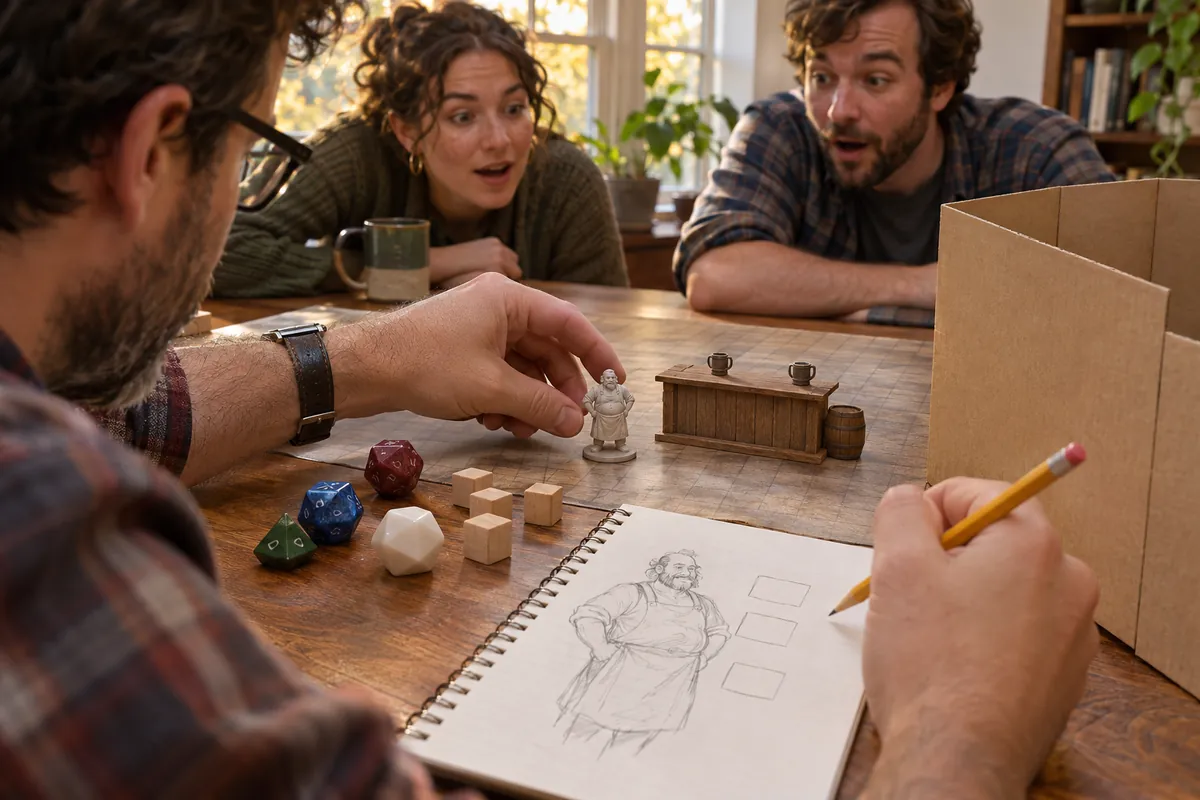
- Write their AC and attack bonus on a sticky note or notecard. You will reference it mid-combat; make it visible, not buried in a sourcebook.
That's the whole generator. Archetype, scaled HP, one trait, visible numbers.
Which SRD stat blocks work best for tavern scenes?
You don't need to memorize dozens of options. A short mental shortlist covers nearly every bar patron who might suddenly matter.
- Commoner — AC 10, 4 HP, club attack. Use for anyone who should lose a fight fast: the bard, the cook, the drunk regular.
- Thug — AC 11, 32 HP, multiattack with a mace. Use for bouncers, hired muscle, or "that guy" at the end of the bar who clearly used to be a soldier.
- Bandit — AC 12, 11 HP, scimitar or light crossbow. Use for anyone with a shady side hustle: smugglers, pickpockets, debt collectors.
- Spy — AC 12, 27 HP, sneak attack and cunning action. Use for the patron who seems to know too much, or the one who vanishes the moment things get loud.
- Noble — AC 15, 9 HP, rapier. Use for the drunk aristocrat who insists on a duel and has a bodyguard nearby.
Keep this list loose in your head, and your tavern scenes stop needing prep entirely. If you want a deeper breakdown of matching archetypes to roles, How to Build a D&D NPC Generator Table goes further into building reusable tables for exactly this situation.
How do I scale an NPC without doing math mid-session?
The trap here is trying to balance an encounter the way you would a planned boss fight. You don't have time, and the scene doesn't need it.
Instead, aim for one of three outcomes and pick your numbers to match:
- The NPC should lose fast. Use base SRD numbers as written. A Commoner or Bandit against a party of three or more will usually go down in one or two rounds.
- The NPC should put up a real fight. Double their hit points and keep everything else as written. This buys two or three extra rounds without touching attack math.
- The NPC should be a genuine threat. Add 2 to their attack bonus and AC, and give them a reaction or bonus action ability pulled from a similar-CR monster. Don't invent new mechanics mid-combat; borrow them.
Whichever outcome you pick, commit to it before the first attack roll. Changing an NPC's toughness mid-fight because the dice went badly reads as unfair, even when your intentions are good.
What should I track once the fight actually starts?
Once initiative is rolled, you need four numbers within easy reach: AC, current HP, attack bonus, and damage die. Nothing else matters in the moment.
Write them somewhere visible, not in a closed book or a buried PDF. A sticky note, an index card, or the corner of your DM screen all work. If you expect this kind of improvised fight more than once a session, a stack of pre-filled cards saves you from reconstructing this every single time.
That's the gap our Tavern NPC Cards for DnD 5e were built to close: sixteen ready-to-drop tavern patrons with stat blocks, a voice note, and a hook already filled in, so you flip a card instead of flipping through a sourcebook. They're not required reading, just a shortcut if this scene keeps happening at your table.
How do I give a throwaway NPC personality mid-fight?
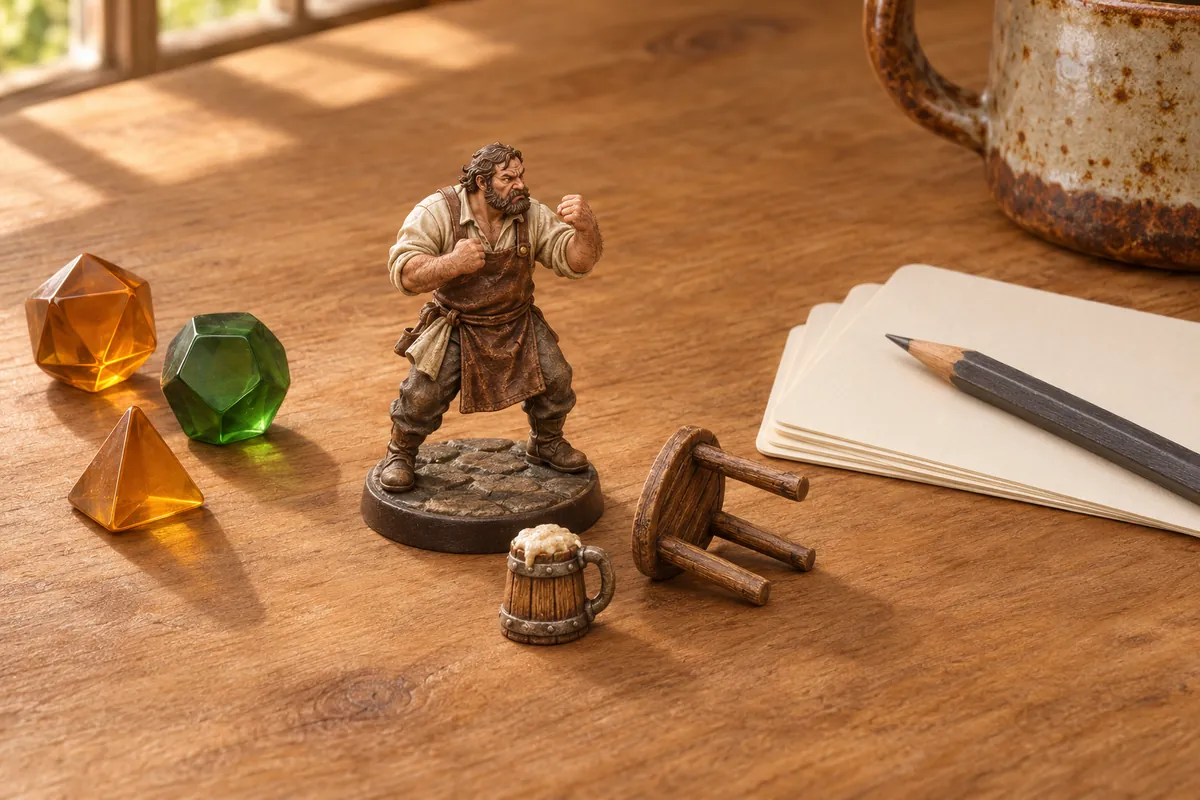
Numbers get the fight moving, but a flat stat block with no voice still feels like filler. You don't need backstory, just one hook you can repeat.
- Give them a catchphrase they say when they attack or get hit ("You'll pay for my mug!").
- Give them a tell: they favor a side, they flinch at fire, they keep glancing at the door.
- Give them a reason to stop fighting that isn't death: they'll flee at half HP, or surrender if disarmed.
These three things take seconds to invent and make the fight memorable even though you made the NPC up twenty seconds before combat started. For more on this, How to Make NPCs Your Players Actually Remember covers building those small hooks into lasting characters.
How do I keep the fight from derailing the session?
An unplanned bar fight can eat thirty minutes if you let it. Keep it tight by capping the stakes before round one: decide whether this is nonlethal, how the watch responds, and what ends the scene.
If the brawl is meant to stay nonlethal, borrow the subdual rules rather than inventing your own; our guide on D&D 5e Bar Fight Rules: How to Run a Nonlethal Tavern Brawl walks through exactly how to run that cleanly.
The core habit worth keeping: always have one archetype and one trait ready for any named NPC before your players can talk to them. Browse the full range of printable tools in the shop if you want more of this kind of table-ready prep on hand.
Parchment & Dice is not affiliated with Wizards of the Coast. Stat block references are drawn from the D&D 5th Edition System Reference Document (SRD 5.1).
Frequently asked questions
- Is there an official d&d random npc stat block generator?
- Wizards of the Coast has not published an official digital generator, but the SRD 5.1 includes reusable stat blocks like Commoner, Bandit, Thug, and Spy that work as a manual generator if you memorize their rough shapes.
- What stat block should I use for a random tavern patron?
- For most patrons, Commoner works fine. If a fight breaks out, Thug or Bandit gives you a believable brawler without slowing the game down.
- How do I make an improvised NPC fight fair without a lot of math?
- Match the NPC's challenge rating loosely to party level, give them one offensive option and one defensive trait, and let a handful of fixed HP absorb the first couple of hits.
- Can a Commoner really fight a 5th-level party?
- Not well, and that is fine. A Commoner is meant to lose fast or flee, which is usually exactly what the scene calls for.
- How many stats does an improvised NPC actually need?
- Four: AC, HP, one attack with a bonus and damage die, and one personality trait. Everything else can be made up as you go.
- dm tools
- npc stat blocks
- tavern encounters
- 5e improvisation
- dungeon master tips
Related reading
- How to Make a D&D Magic Item Feel Legendary, Not Just UsefulLearn how to make DnD magic items feel special with sensory detail, personality, and history instead of just stat bonuses.
- How to Assign Stat Blocks to a City NPC in MinutesA fast method for picking a dnd npc stat block for city encounters, using SRD monsters as reskinned stand-ins so you never stall a scene.
- How to Build a D&D NPC Generator TableBuild a D&D NPC generator table that gives you quick names, motives, mannerisms, and useful hooks during play.