November 4, 2026 · 7-min read
How to Run a D&D Shopping Scene Without Stalling the Session
The party just wants a rope and a few torches. Forty minutes later, you are still haggling over a lantern.
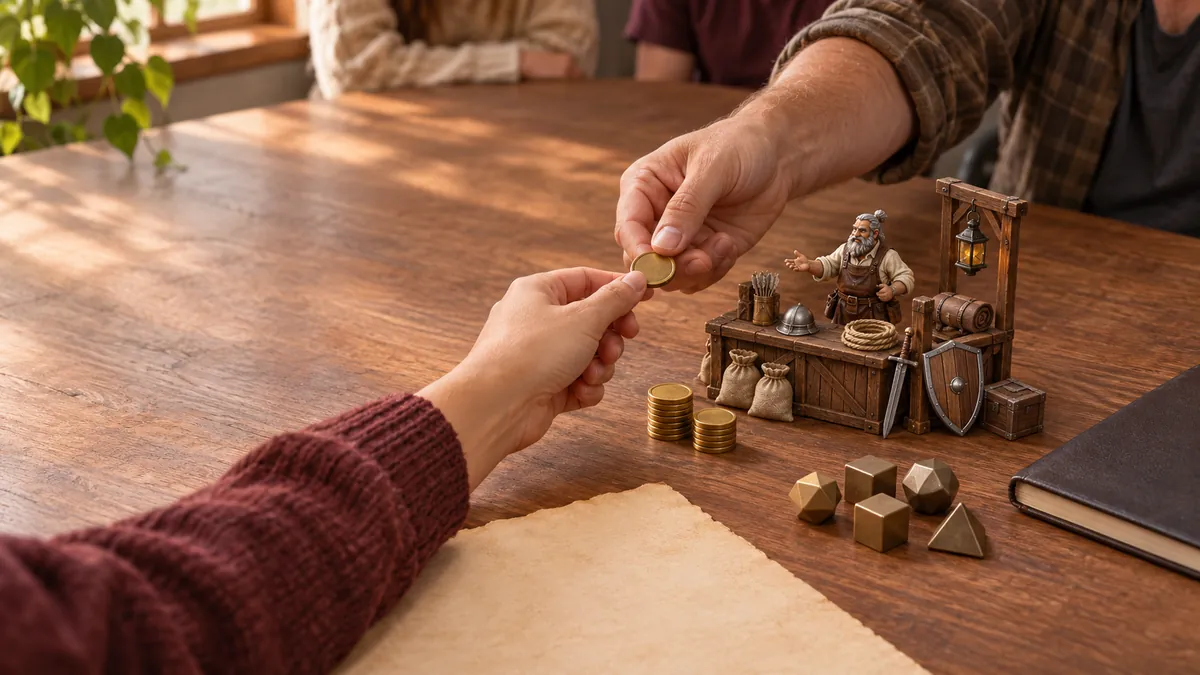
To run a shop in DnD without stalling the session, treat it as a short scene with a clear goal: a shopkeeper with one memorable trait, a short stock list priced from the SRD equipment tables, and a hard stop after a few minutes. Ordinary gear is a quick yes. Only unusual requests deserve a roll or a roleplay beat.
This guide gives you a repeatable five-step method, a pocket stock list, and copy-paste wording for the moments when players ask for something you did not plan.
What makes a shopping scene drag?
Shopping stalls for three predictable reasons. Knowing them lets you fix them before the party reaches the market.
- No stock list. You flip through books looking for prices while everyone checks their phones.
- Every item is a negotiation. Six players each haggling over a different purchase turns one scene into six.
- No goal. Without a reason to be there beyond "we browse," the scene has no natural end.
The fix for all three is preparation measured in minutes, not hours. If you are still building your prep routine, how to prep a D&D session in 30 minutes pairs well with everything below.
How do I run a shopkeeper scene in five steps?
Use this order every time. After two or three sessions it becomes automatic.
- Frame it in one sentence. "The general store smells like lamp oil and wet rope. A broad woman looks up from her ledger." Done.
- Give the shopkeeper one hook. One voice, one quirk, one want. A shopkeeper who hums off-key and wants gossip is enough.
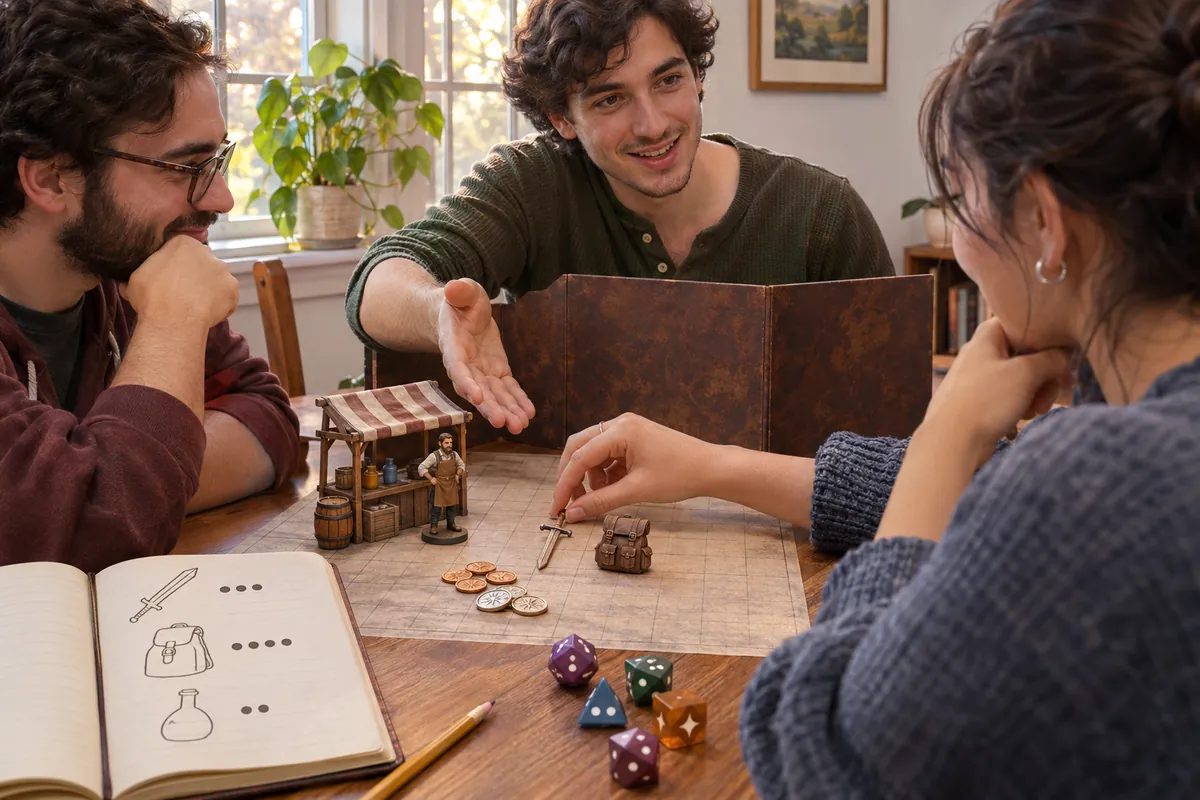
- State what is on offer. Read your short stock list aloud or hand it to the table. Players decide faster when they can see the options.
- Resolve purchases in a batch. Let everyone say what they want at once. Subtract coin, hand over items, and move on.
- End with a nudge. A rumor, a request, or a closing bell. This gives the scene a reason to finish.
How do I set prices from the SRD equipment lists?
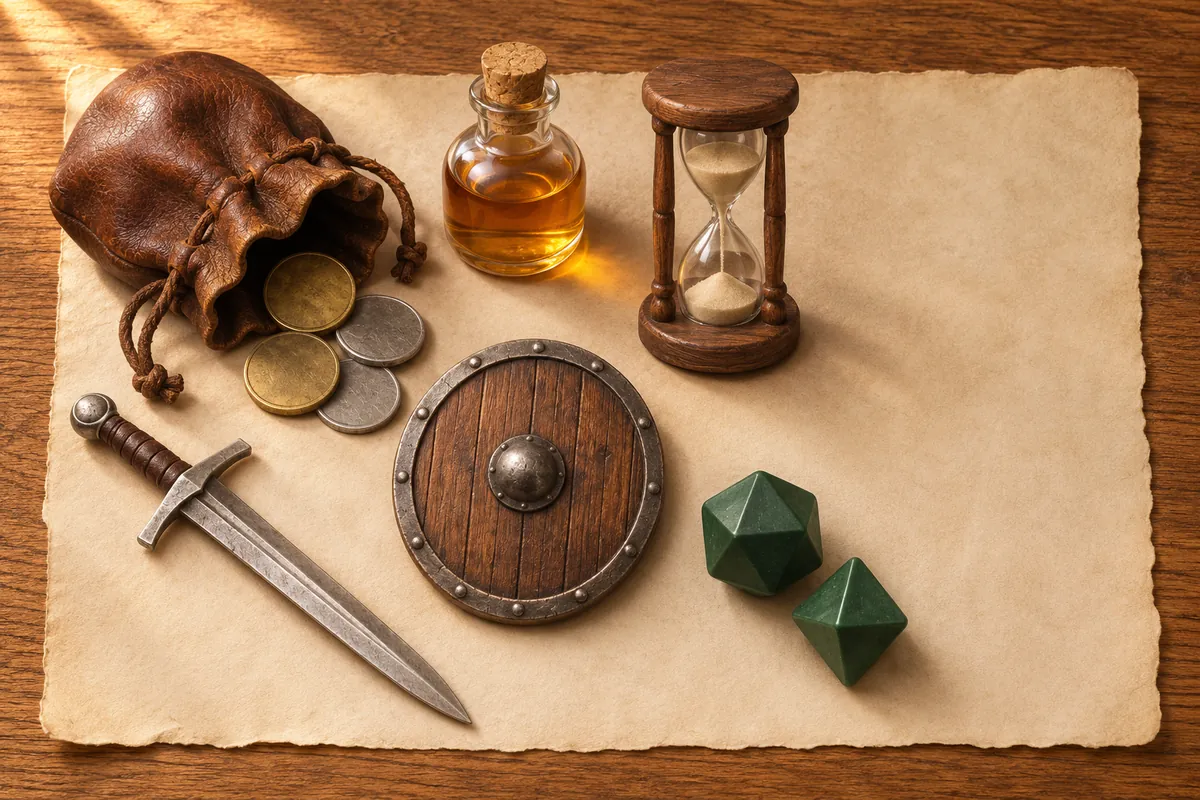
Start with the listed price and treat it as the default. The SRD 5.1 equipment tables cover armor, weapons, and adventuring gear, so you rarely need anything else for a basic shop. (This site is not affiliated with Wizards of the Coast; we only reference SRD 5.1 material.)
Here is a sample stock list for a small-town general store, using SRD prices:
- Backpack: 2 gp
- Bedroll: 1 gp
- Hempen rope (50 feet): 1 gp
- Torch: 1 cp
- Rations (1 day): 5 sp
- Waterskin: 2 sp
- Crowbar: 2 gp
- Hooded lantern: 5 gp
- Flask of oil: 1 sp
- Healer's kit: 5 gp
A blacksmith might add a dagger (2 gp), a shield (10 gp), leather armor (10 gp), and a longsword (15 gp). A bigger city could carry chain mail at 75 gp. Check the SRD tables for anything else before you quote a number.
When should I change the price?
Only change prices when the story gives you a reason. A few simple adjustments:
- Remote location: add about 10 to 25 percent.
- Shortage or crisis: add about 25 to 50 percent, and tell the players why.
- Friendly shopkeeper: knock off a small amount as a reward for good roleplay.
Keep the math easy. Round to the nearest silver or gold so no one needs a calculator.
How do I handle haggling without a 20-minute debate?
Offer one haggle per scene, not one per item. Ask the player to describe their approach, then call for a single Charisma (Persuasion) or Charisma (Intimidation) check.
- DC 10: a friendly shopkeeper with room to move.
- DC 15: a shopkeeper who likes their margins.
- Success: about 10 percent off the whole order.
- Failure: the price holds, and the shopkeeper may be a bit cooler to the party.
That is the whole system. Players still feel clever, and you avoid a back-and-forth on every purchase. If you want a model for keeping skill rolls tight, how to run a skill challenge that feels fair uses the same principle of one clear goal and a limited number of rolls.
What do I say when players ask for something I do not have?
You will get requests you did not plan for. Keep a few lines ready so you never freeze:
- Common item: "Sure, that is on the shelf. Standard price."
- Uncommon item: "I do not stock that, but I could order one. A week and a bit extra."
- Not available here: "No one in a town this size sells that. You will want a bigger city."
- Magic item: "Nothing like that on these shelves. Though I heard a collector in the next town over..."
That last line turns a "no" into a hook. Players rarely mind a refusal when it points somewhere.
How do I keep shopping from eating game time?
A few table habits help more than any rule.
- Set a timer. Tell players they have about five real-world minutes before the shop closes.
- Shop between sessions. Let players send you a list by message beforehand and hand over a receipt at the start.
- Use a shared ledger. One player tracks the party's purchases so you are not recounting coin.
- Skip the trivial. Torches, rations, and rope do not need a scene. Deduct the cost and carry on.
- Reserve roleplay for what matters. If a purchase drives the plot, like a rare component for a quest, spend time on it. Otherwise, summarize.
Buying and selling also ties into treasure. Players often arrive at the shop with loot to sell, so a plan for dividing it first saves arguments later. See how to split loot in D&D 5e without party arguments for that side of the coin.
A common table rule is that shopkeepers buy back mundane gear at about half price. Decide that once, tell the table, and stick to it.
What should I prep for each shopkeeper?
You only need a handful of lines on an index card:
- Name and shop type
- One physical detail: ink-stained fingers, a missing tooth, a parrot on the shoulder
- One voice note: slow and deliberate, or rapid and chatty
- One want: gossip, a delivery, a debt repaid
- One rumor or hook to hand the players on the way out
- Six to ten items with prices
That is a full shopkeeper. If the party wanders into an unplanned store, borrow the details from your last NPC and change the voice.
Is there a faster way to get ready-made shopkeepers?
If you would rather not write these from scratch, a stack of prepared NPCs makes city scenes much easier. Our City NPC Cards for DnD 5e include 16 urban characters with stat blocks, voice notes, and hooks, so a merchant, innkeeper, or smith is ready the moment the party walks in. They are a printable you can shuffle at the table.
You can also browse the rest of our printable DM tools in the shop if you want more table-ready aids.
Quick checklist before your next shop scene
- Pick one shopkeeper hook and one rumor.
- Write a six-to-ten item stock list with SRD prices.
- Decide on one haggle check per scene.
- Settle your sell-back rate.
- Set a loose time limit and a clear end beat.
Run it that way and the shop becomes what it should be: a small, flavorful pause that sends the party back toward the adventure with better gear and a new lead.
Parchment and Dice is not affiliated with Wizards of the Coast. References are to SRD 5.1 content only.
Frequently asked questions
- How much should I charge players for gear in D&D 5e?
- Use the prices printed in the SRD equipment tables as your default. Adjust by a small amount, like 10 to 25 percent, only when the location or the story gives you a reason, such as a remote village or a supply shortage.
- Should players be able to buy anything they want in town?
- No. Ordinary gear should be easy to find, but you can decide a small town simply does not stock heavy armor or specialty items. Telling players what is not available is a quick, honest way to keep the scene short.
- How do I stop shopping from taking over the session?
- Set a time limit, use a short stock list, and let players buy common items without rolling. Move bigger purchases to downtime or a single scene with a clear goal.
- Do I need a full price list for every shop?
- No. Pick six to ten items the shop sells, note their prices, and improvise the rest. Anything off the list can be a simple yes, no, or 'I can order that in'.
- dm tips
- shopping
- npcs
- equipment
- worldbuilding
Related reading
- D&D 5e Opportunity Attacks: When They Trigger and How to Avoid ThemLearn how dnd 5e opportunity attacks work: what triggers them, what counts as leaving reach, and how Disengage and teleporting avoid them.
- How to Run Concentration in D&D 5e: Rules, Examples, TipsHow does concentration work in D&D 5e? Learn the Constitution save DC, what breaks it, and simple ways to track it at the table.
- How to Make a D&D Magic Item Feel Legendary, Not Just UsefulLearn how to make DnD magic items feel special with sensory detail, personality, and history instead of just stat bonuses.