
November 2, 2026 · 7-min read
D&D 5e Opportunity Attacks: When They Trigger and How to Avoid Them
One step in the wrong direction and the orc gets a free swing. Here is exactly when it happens, and how to slip away clean.

An opportunity attack is a free melee attack that a creature can make, using its reaction, when a hostile creature it can see moves out of its reach. In dnd 5e opportunity attacks only trigger on that specific kind of movement, which means you can avoid them with the Disengage action, teleportation, or by being moved without spending your own movement.
This post covers rules from the SRD 5.1 only. Parchment & Dice is not affiliated with Wizards of the Coast.
When does an opportunity attack trigger?
Three things must be true at the same moment:
- A creature moves out of another creature's reach.
- The creature that might attack is hostile to the mover and can see it.
- The attacker still has its reaction available this round.
When all three line up, the attacker can make one melee attack. That attack happens right before the mover leaves reach, so it interrupts the movement. If the attack drops the mover, that is the end of its escape.
Most creatures have 5 feet of reach, which on a grid means any of the eight squares around them. Creatures with a reach weapon, such as a glaive or a whip, threaten a bigger area, and some monsters have longer natural reach. Check the weapon or stat block.
What counts as leaving reach?
Leaving reach means ending a step in a space the attacker can no longer touch. Here are the common cases:
- Stepping away from an adjacent enemy. This is the classic trigger.
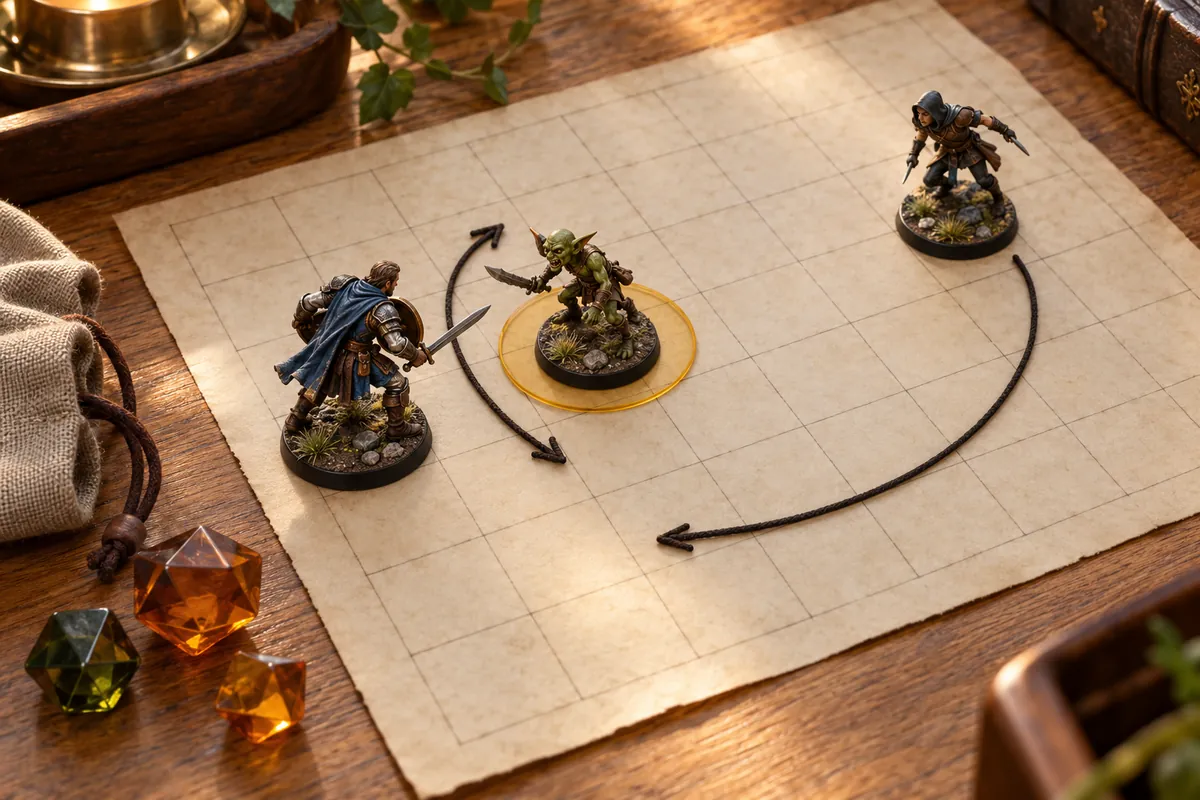
- Moving from one threatened square to another. If both squares are inside the enemy's reach, there is no trigger. Circling an enemy is free.
- Moving through reach. If your path starts outside reach, enters it, and exits the other side, you provoke on the way out.
- Flying or climbing away. How you move does not matter. Leaving reach is leaving reach.
- Escaping two enemies at once. Each enemy whose reach you leave can use its own reaction against you.
Walking toward a monster never provokes. You only pay the price when you try to leave.

What does not provoke an opportunity attack?
Plenty of actions that feel risky are actually free:
- Shooting or casting at point-blank range. Ranged attacks do not provoke, though you do have disadvantage on a ranged attack roll if a hostile creature is within 5 feet of you.
- Standing up from prone. It costs half your movement, but it is not leaving reach.
- Being shoved, pushed, or thrown. Forced movement does not use your movement, action, or reaction, so it does not provoke.
- Falling. Same logic as above.
- Moving away from an ally. The rule only covers hostile creatures.
- Moving away from something that cannot see you. An attacker needs to see its target. Invisibility or total darkness can protect you, but only if the enemy truly cannot perceive you.
How do I avoid opportunity attacks with Disengage?
Disengage is the simplest answer. Take the Disengage action and your movement does not provoke opportunity attacks for the rest of the turn.
Here is how it usually plays out:
- You are in melee with a bandit.
- You use your action to Disengage.
- You move up to your full speed away, and nobody gets a free swing.
The cost is your action, so you are not attacking this turn. Dash and Disengage compete for the same action, which means you cannot both sprint and escape cleanly without help. Rogues get Disengage as a bonus action through Cunning Action, and monks can do the same with Step of the Wind by spending a ki point. Both are in the SRD.
Can teleporting or forced movement avoid them?
Yes. The rules state that you do not provoke when you teleport, and you do not provoke when something moves you without using your movement, action, or reaction.
A few SRD examples:
- Misty Step. A bonus action teleport of up to 30 feet. You vanish and reappear without ever "moving out of reach."
- Dimension Door. A bigger teleport for when you need to leave the whole battlefield.
- Thunderwave. The spell pushes creatures that fail the save 10 feet. A pushed creature does not provoke, so allies can use it to pull the party out of a bad spot.
- A well-placed shove. A creature shoved away by an ally does not provoke, because the movement is not its own.
Be careful with the reverse case too. If you voluntarily walk after being pushed, that new movement can provoke like any other.
How can I stop an enemy from using its reaction?
Anything that removes a creature's reaction removes its opportunity attack. The SRD shocking grasp cantrip is a clean example: a creature it hits cannot take reactions until the start of its next turn. Conditions that make a creature incapacitated also prevent reactions, so stunned, paralyzed, and unconscious enemies cannot punish you for walking past. If you want a full refresher, see our guide to D&D 5e conditions explained.
Also remember that a creature gets one reaction per round. If a goblin already spent its reaction on a different trigger, you can slip by.
How should DMs run opportunity attacks fairly?
A few habits keep combat moving and keep players happy:
- Announce reach when it matters. If a monster has a long weapon, say so before the player commits to a path.
- Remind players when they leave reach. A quick "that will provoke, still want to do it?" avoids take-backs.
- Use opportunity attacks with monsters, too. Players learn the system faster when enemies respect it, and it makes retreating feel like a real choice.
- Resolve it before the move finishes. Roll the attack, apply the result, then see whether the mover is still standing.
- Check the grapple rules. Grappled creatures have speed 0, which changes how escape works. Our grappling rules guide covers how shoves and grapples interact with movement.
What is the quick checklist for players?
Before you move away from an enemy, ask yourself:
- Am I leaving their reach, or just shifting around inside it?
- Can they see me?
- Do they still have a reaction?
- Can I Disengage, teleport, or get pushed out instead?
- Is the free attack worth the position I gain?
Sometimes taking the hit is right. A wizard retreating from a goblin may happily eat one attack to get a better line for a fireball. Opportunity attacks are a price, not a ban.
Is there a handy reference for this at the table?
Reactions, incapacitated, prone, and the other conditions that change who can punish whom come up constantly during combat. If you want them in one glance, the DnD Conditions Cheat Sheet is a printable reference poster you can hang near your game table or keep beside the DM screen. You can also browse everything else in the Parchment & Dice shop.
Whether you are the one running from the ogre or the one swinging at the runner, knowing the exact trigger keeps the table honest and the fights fast.
Frequently asked questions
- Do ranged attacks trigger opportunity attacks?
- No. Firing a bow or casting a spell does not trigger an opportunity attack, because the trigger is leaving a creature's reach. However, making a ranged attack while a hostile creature is within 5 feet of you gives you disadvantage on the attack roll.
- Can you make an opportunity attack with a spell?
- Not under the core rules. An opportunity attack is a single melee attack, so a normal spell cast does not qualify. Some features and feats change this, so check your table's rules for those.
- Does Dash avoid opportunity attacks?
- No. Dash only gives you extra movement for the turn. If you move out of an enemy's reach, you still provoke, so you need Disengage, teleportation, or a way to be moved without using your own movement.
- Can you take more than one opportunity attack per round?
- Each opportunity attack costs your reaction, and you get one reaction per round. If two enemies leave your reach in the same round, you can only punish one of them unless you have a feature that grants extra reactions.
- Does moving around inside an enemy's reach provoke?
- No. Opportunity attacks trigger when you move out of reach, not when you move within it. You can circle an enemy while staying adjacent without provoking.
- opportunity attacks
- combat rules
- dnd 5e
- disengage
- reactions
- dm tips
Related reading
- How to Run a D&D Shopping Scene Without Stalling the SessionLearn how to run a shop in DnD with a simple five-step scene, SRD prices, and a few shortcuts so buying gear never eats your session.
- D&D 5e Grappling Rules: How to Grapple, Escape, and ShoveD&D 5e grappling rules explained: how to grapple, escape, and shove, with size limits, Athletics vs. Acrobatics checks, and speed effects.
- How to Track Spell Slots in D&D 5e (Simple Methods That Work)Learn how to track spell slots dnd 5e style with beads, checkboxes, and tokens, plus a simple routine for recovering slots after a rest.